
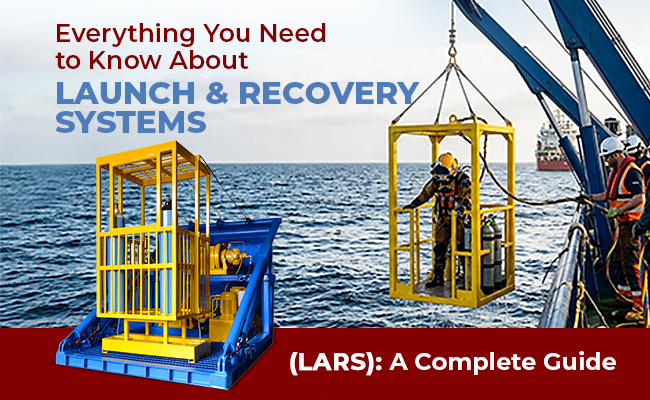
Launch & Recovery Systems (LARS) play a vital role in subsea, offshore, and marine operations. They are engineered to safely deploy and retrieve equipment, vehicles, and personnel in challenging environments, ensuring operational efficiency and safety. In offshore and subsea projects, these systems are indispensable for maintaining smooth and controlled operations.
A LARS launch and recovery system is specifically designed to provide stability and precision during deployment and retrieval. By compensating for vessel motion and controlling loads, it reduces the risk of accidents and protects both personnel and valuable underwater equipment. This makes it a critical component for safe and reliable offshore operations.
Several industries rely on LARS for their marine and subsea operations. In oil & gas, LARS supports offshore platforms by handling ROVs, subsea tools, and inspection equipment safely. The renewable energy sector uses these systems for installing and maintaining offshore wind turbines and underwater monitoring devices. Marine research depends on LARS to deploy scientific instruments, autonomous vehicles, and exploration sensors, while defense operations utilize LARS for underwater surveillance, reconnaissance, and specialized military missions.
For commercial and professional diving, the LARS diving system ensures divers are deployed and recovered safely, even in rough sea conditions. It provides precise handling of diving baskets, wetbells, and diving bells, improving operational efficiency while prioritizing diver safety. Modern LARS diving systems may also include monitoring and control features that further enhance safe underwater operations.
In short, Launch & Recovery Systems and their applications, including the LARS diving system, are essential for safe, efficient, and reliable subsea, offshore, and marine operations across multiple industries.